Floor Is Lava - Netflix
Back in 2019 I worked on a brand new show called 'Floor is Lava'. I had no idea it had ever saw release, let alone be the top Netflix show of June 2020! I worked on this freelance for a fairly long time so prepare yourselves for many images!
My job was to recreate after it had all been filmed, the entire sets and every item within them. match lighting , surface types, model them, texture them and extend the sets for the 3D camera moves. The lava itself I wasn't responsible for (although i did provide a basic simulation to the team working on that. ) So a basic guide as to what I worked onis if the shot doesnt have a person in it and its not lava, then its 3D and done by me.
But as for the stuff I've mentioned....I was the only guy working on that. This was a full 'balls to the wall' workflow to get things done on time to the right quality. My job was not to make the rooms or items witnin them look better than their real life counterparts, but to match them exactly as much as possible and crank through them at (to be frank) an insane speed.
Each item also had to be as low res as possible, my entire workflow was done in 3Ds Max and then had to be converted over to be rendered eventually through Cinema 4D. Now as any 3D person knows , the various media and entertainment application from different software vendors do not always play nicely with each other. so after lighting and setting up shaders and materials for everything, I then had to run each one through some mathematical algebra to convert the lights so that they would look exactly the same when rendered from Cinema 4D as they did in 3Ds Max.
The Workflow:
Ok this might get a bit long.
Basically just before the sets were torn down (which were filmed in an old IKEA I belive) numerous photos were taken in the hopes of using them to create a photogramatry scan of the sets. This worked...... however the scans were in no way usable for the purpose other than as lighting, shape and texture reference. So after some tests to see if they could be fixed, the only decision was to recreate every single set and item within them manually, in a very short time.
My workflow as to bring in a polyreduced version of the scan (using my old App I wrote years back called 'ReDucto', which still works better than anything else out there BTW) and use that as a reference while modelling each item.
I would then texture each item and set up the materials for them. Then once each set was done, a far lower still polycount version was made for the 'grid' version you see in the animations.
For the set extensions together with the director, we both worked dout some basic ideas for a single room shape that could be reused with some very basic set dressing. As these wouldn't be visisble very mch and blurred a fair old bit with depth of field in composite they didn't need to be too fantastically perfect. We cut as many corners as we could while keeping things looking to the right level to enable the show to get out of the door on time and on budget.
Below you can see various renders (at half HD resoltuion as they were only tests) from various stages of the work on each room. Two rooms it seems didn't make it to series One, so I'll keep those back until they apears (I am assuming ) in Series 2. I think given its massive sucess its pretty much a given that a 2nd series will be made! But to be 100% clear Ihave no inside info on that...I'm only guessing.
They gave me freedom in areas I knew a lot about and took on board any areas I saw a potential problem at a future point in the pipeline. It was certainly hectic though! As in an ideal world you would have had about 4-8 people working on this, but as I am known to be able to work fast and acccurately I got the job done, with minimal stress to the satisfaction of all concerned. They even set me a Floor is Lava hat and top over as thank you.
DISCLAIMER:
What you see here are raw renders from various stages in the post production process with no depth of field, render and lighting noise and only a very basic red shader applied to the 'Lava' for the purposes of visualisation purposes during post production. Every item onset had to be either modelled and textured or sourced (although this mainly only happened on the 2 rooms as yet unused). Any mistakes that would be blurred out in depth of field or not visible for more than a microsecond are left visible and unfixed.


the yellow submarine I'm pretty sure was dumped before we final'd the room


a selectionof the hundreds of 'grid' low res props

Light fitting

early grey blockout for the extension

early grey blockout for the extension

early grey blockout for the extension

early grey blockout for the extension
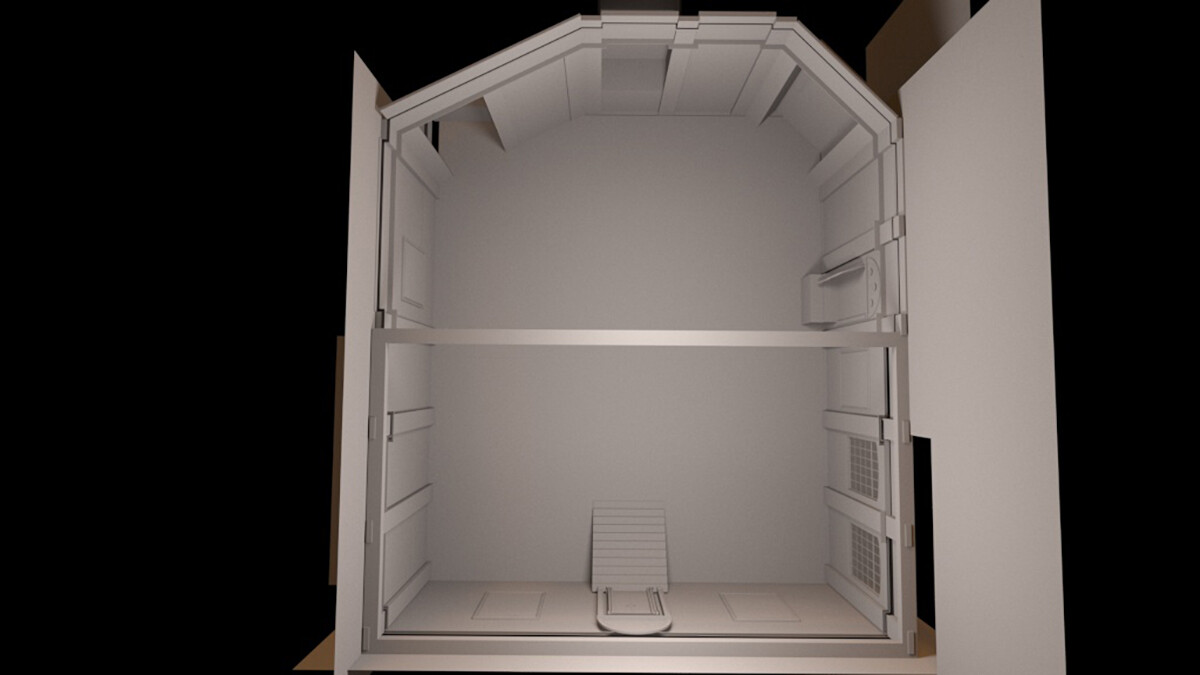
early grey blockout for the extension

WIP of an early version of the planetarium

Kitchen pan props

more props

yet more props

space suit....